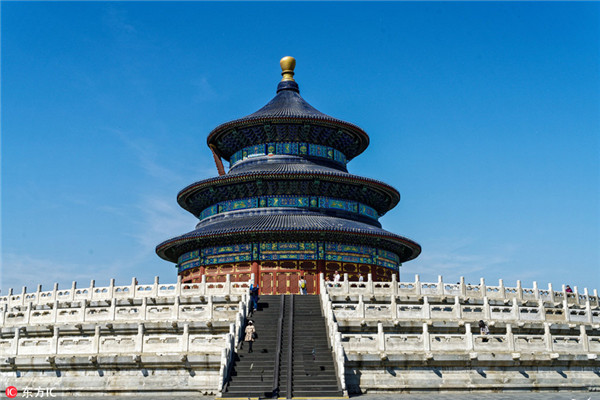
The Temple of Heaven
Introduction
The Temple of Heaven, situated in the southern part of Beijing, is a grand complex of cultural heritage buildings set amidst picturesque gardens and historic pine woods. Renowned for its architectural grandeur and historical significance, it has been a sacred site for over five centuries. The complex served as a sacral sanctuary for the Ming and Qing emperors who performed important sacrificial ceremonies to Heaven, praying for good harvests and prosperity. Its architectural design and layout encapsulate the profound relationship between heaven and earth, reflecting the emperors' unique role as mediators between the human and divine realms within Chinese cosmogony.
History
The history of the Temple of Heaven dates back to the early 15th century, specifically to the year 1420, during the reign of the Ming Dynasty's Yongle Emperor. Originally constructed alongside the Forbidden City, the site was initially known as the Altar of Heaven and Earth. In 1530, during the reign of the Ming Emperor Jiajing, a decision was made to separate the sacrifices to heaven and earth. Consequently, the Circular Mound Altar was built to the south of the primary sacrificial hall, dedicated exclusively to heavenly offerings. The complex was later expanded and renovated by the Qing emperors Qianlong and Guangxu in the 18th century, culminating in its current form by 1749. This site has witnessed numerous royal ceremonies and has remained a symbol of imperial power and cosmic harmony throughout Chinese history.
Architecture
The architectural design of the Temple of Heaven is a testament to the intricate beliefs and advanced engineering of ancient China. The complex's layout is meticulously planned along an axial arrangement, centering around significant structures such as the Circular Mound Altar, the Imperial Vault of Heaven, and the Hall of Prayer for Good Harvests.
Design and Layout
The design of the Temple of Heaven is deeply symbolic. The southern section of the complex is square-shaped, symbolizing Earth, while the northern section is semi-circular, representing Heaven. This layout embodies the ancient Chinese belief in the cosmic order of a round Heaven and a square Earth. The Circular Mound Altar, positioned to the south, is an open-air platform where the emperors conducted prayers and sacrifices to Heaven. Immediately north of the altar stands the Imperial Vault of Heaven, a structure linked by a sacred pathway to the Hall of Prayer for Good Harvests further north. This layout facilitated the ritualistic journey of the emperors, acting as intermediaries between humanity and the celestial realm.
Materials and Construction
The Temple of Heaven is renowned for its construction without the use of nails, emphasizing the sophisticated carpentry skills of ancient China. The primary structures are made entirely of wood, with the roofs covered in deep-blue tiles to harmonize with the sky. The Circular Mound Altar is a three-tiered marble terrace adorned with tiles of blue glaze. The architectural elements are rich with numerological symbolism, adhering to the imperial reverence for the number nine, which represents the ultimate celestial power. The Hall of Prayer for Good Harvests, initially constructed in 1420, reflects cosmological themes in its design, with its triple-eaved, cone-shaped roof, supported by 28 wooden columns symbolizing the four seasons, 12 months, and 12 divisions of the day.
Cultural Significance
The Temple of Heaven holds immense cultural significance as a reflection of China's imperial history and religious practices. It symbolizes the emperors' divine right to rule and their role as intermediaries between heaven and earth. The rituals conducted at the temple were believed to ensure cosmic harmony and the well-being of the empire. The temple's architectural principles also embody ancient Chinese cosmology, emphasizing the harmony between the human and divine realms. As a cultural heritage site, the Temple of Heaven is not only a testament to China's historical and architectural achievements but also a symbol of its enduring cultural identity and philosophical traditions.
Rituals and Ceremonies
The Temple of Heaven was the venue for significant imperial rituals, most notably the ceremonial sacrifices to Heaven conducted by the Ming and Qing emperors. These rituals were held annually during the winter solstice and other key agricultural festivals, reflecting the emperors' role in ensuring bountiful harvests and the prosperity of the nation. The ceremonies were elaborate, involving processions, offerings, and prayers, and were attended by high-ranking officials and musicians. The rituals were designed to appease the divine forces and reinforce the celestial mandate that legitimized the emperor's rule. The temple's design facilitated these rituals, creating a sacred space where the emperors could commune with the heavens.
Influence on Art and Literature
The Temple of Heaven has had a profound impact on Chinese art and literature, inspiring countless works that celebrate its architectural beauty and symbolic significance. Its iconic structures and the rituals performed within its grounds have been depicted in traditional paintings, poetry, and literature, serving as a source of inspiration for artists and writers throughout Chinese history. The temple's influence extends beyond China, captivating the imagination of international artists and cultural enthusiasts who admire its architectural elegance and historical legacy. The Temple of Heaven continues to be a subject of artistic exploration and scholarly research, reflecting its enduring cultural resonance.
Preservation and Conservation
Preserving the Temple of Heaven is crucial to maintaining its historical and cultural legacy. As a UNESCO World Heritage Site since 1998, efforts have been made to protect and restore its structures, ensuring their integrity for future generations. Conservation work includes repairing structural damage, restoring decorative elements, and maintaining the surrounding gardens and landscapes. The preservation efforts are guided by principles that respect the site's historical authenticity while enhancing its accessibility for educational and cultural purposes. The Temple of Heaven serves as a living testament to China's rich architectural and cultural heritage, highlighting the importance of conservation in safeguarding historical sites worldwide.
Tourism and Visitor Information
The Temple of Heaven is a popular tourist destination, attracting millions of visitors annually who are eager to experience its historical and cultural significance. Located in Beijing's Dongcheng district, the site is easily accessible by public transportation and offers a range of visitor amenities, including guided tours, educational exhibits, and cultural performances. Visitors can explore the temple's iconic structures, including the Hall of Prayer for Good Harvests and the Circular Mound Altar, and enjoy the serene gardens and historic pine woods surrounding the complex. The Temple of Heaven provides an enriching experience for those interested in China's imperial history, architecture, and cultural traditions.








